19 Nov
The short answer: FareHarbor fees are not charged to you as a subscription. A booking fee is added to your guest’s checkout as its own line, reported at roughly 6–8%, with card processing on top. On a $1,200 trip, a 6% fee means your guest sees $1,272 at checkout. Whether that is a fair trade depends on where your bookings come from.
1. How FareHarbor charges
FareHarbor has no monthly subscription for operators. Each direct booking carries a booking fee that the guest pays at checkout. That fee is how FareHarbor gets paid.
FareHarbor does not publish a fee schedule. Third-party reviews put the fee at roughly 6–8%, depending on the operator’s agreement. Those sources are CaptainBook (April 2026) and Levy Fleets, as cited on our FareHarbor comparison page, checked October 28, 2026.
Confirm your own rate with FareHarbor, because terms change.
Card processing is charged on top. That part applies to every booking system, including ours.
2. What your guest sees at checkout
Your trip page says one price. When the guest reaches checkout, a booking fee shows up as a separate line. The total they pay is higher than the price you advertised.
Here is how that looks on a few example trips. These are examples only, using the reported 6% and 8% range.
| Your trip price | Fee at 6% | Guest pays at 6% | Fee at 8% | Guest pays at 8% |
|---|---|---|---|---|
| $450 half day | $27 | $477 | $36 | $486 |
| $750 full day | $45 | $795 | $60 | $810 |
| $1,200 offshore trip | $72 | $1,272 | $96 | $1,296 |
Some guests will not mind. Others notice the extra line, wonder why the price changed, and leave to compare. You only ever see the bookings that went through.
3. What the fee adds up to over a season
A fee your guests pay is still money leaving your trips. It is part of what a day on your boat costs them, even if it never touches your account.
Take an example season of $40,000 booked direct. At a 6% guest fee, that comes to $2,400 a year in fees, or $7,200 over three seasons. At 8%, it is $3,200 a year.
RIVERRISE BOOKINGS is $99 a month, or $1,188 a year. Over the same three seasons that is $3,564, and your guests pay exactly the price you set. You can run your own numbers in our total-cost calculator.
4. The other trade-off: who holds the money
With FareHarbor, payouts come through FareHarbor. With RIVERRISE BOOKINGS, deposits go straight to your own Stripe account. Standard Stripe card processing still applies.
It also matters who holds the guest list. With a booking system on your own site, every guest’s email and phone number stays with you. That list is how you bring guests back next season and sell gift certificates in December.
5. What RIVERRISE BOOKINGS does instead
RIVERRISE BOOKINGS is booking software that runs on your own website. There are no booking fees for you or your guests. It works on most websites, including WordPress, Squarespace, Wix and custom builds.
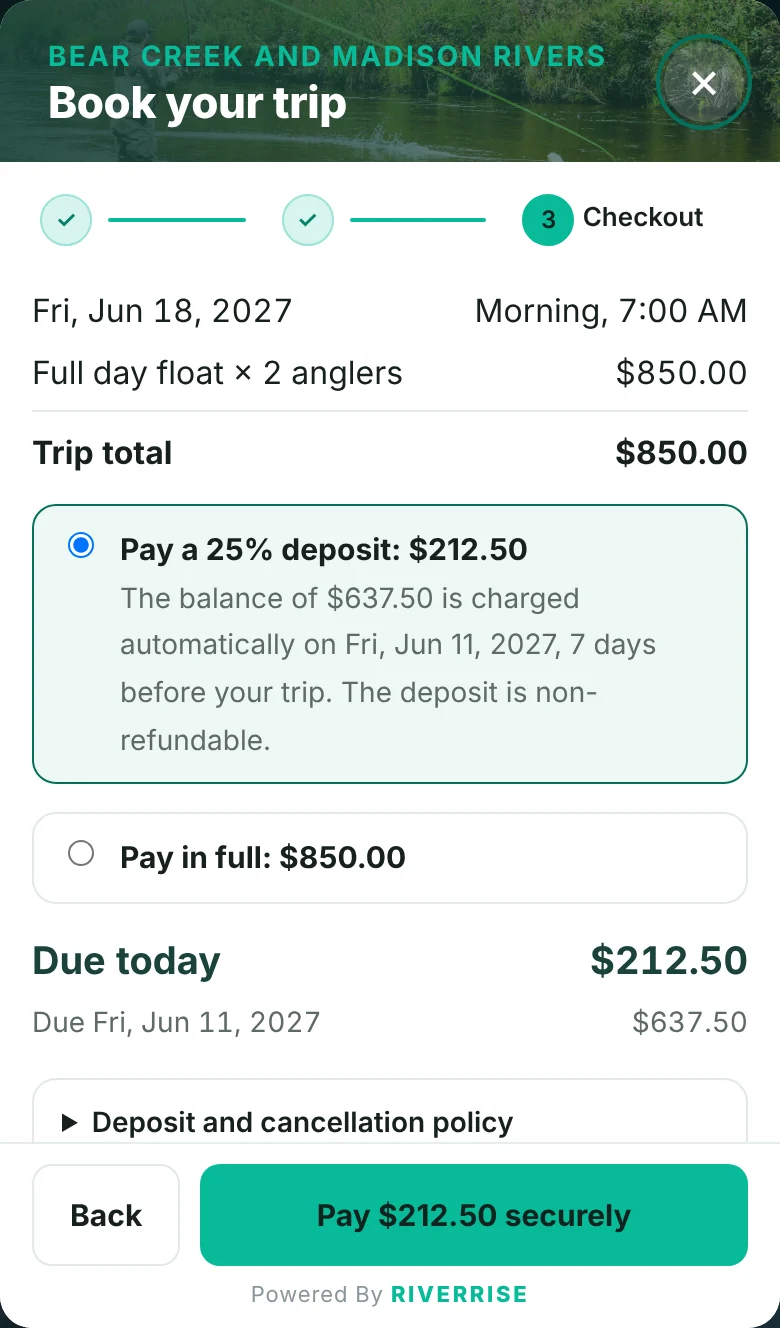
- Clear totals: guests pick a trip and date, see the full total, pay a deposit, and see the balance date.
- Automatic balances: the saved card is charged 7 days before the trip. If a card declines, the guest gets a pay link and 24 hours to pay.
- Online waivers: guests sign on their phones before the trip.
- Weather cancellations: one button cancels the trip, and guests choose to rebook or get a refund.
- Review requests: sent after the trip.
- Gift cards: sold through your own Stripe.
- Staff phone app: trips by start time, waivers and balances at a glance, and text-to-pay links for callers.
Want to see it with your own trips? Book a free demo, or click through the demo guide service, Bear Creek Outfitters.
6. Where FareHarbor still fits
To be fair, FareHarbor does things RIVERRISE BOOKINGS does not. It is built for all kinds of tours and activities, and it connects to a large reseller network.
- Resellers sell most of your trips: if bookings come through Viator, GetYourGuide, hotels or other partners, that reach can justify the fees. RIVERRISE BOOKINGS is built for guests who book with you directly.
- You sell far more than fishing: tours, rentals and lodging under one roof fit a general activity platform better.
- You want zero monthly cost: if you are fine with guests paying a fee at checkout, FareHarbor costs you nothing up front.
- You run a large multi-dock team: some big operations rely on FareHarbor’s check-in tools.
If most of your trips are booked direct by guests who found you, though, the fee is paying for distribution you are not using.
7. Switching without losing a trip
Switching does not mean cancelling anything. The import tool brings over upcoming bookings, past guests, open gift cards and blocked dates from a FareHarbor export. Balances on imported bookings are collected with an emailed pay link before the trip.
FareHarbor finishes the bookings it already holds, and new bookings come in through your own site. Migration of upcoming bookings is included, and the off-season is the easiest time to move.
For a wider look at marketing your trips, see our fishing charter marketing playbook.
FareHarbor fee questions
How much are FareHarbor fees?
FareHarbor has no monthly subscription for operators. It adds a booking fee to each guest’s checkout, reported by third-party reviews at roughly 6–8%, with card processing on top. FareHarbor does not publish a fee schedule, so confirm your rate with them (our figures were checked October 28, 2026).
Who pays the FareHarbor booking fee?
Your guest does. It appears as its own line at checkout, on top of your trip price. You do not pay it directly, but it raises what a trip with you costs.
Is there a FareHarbor alternative with no booking fee?
Yes: RIVERRISE BOOKINGS is $99 a month, month to month with 30 days’ notice, with no booking fee for you or your guests. Setup is $0 if you sign by December 31, 2026, then $500. If setup was waived and you cancel within 12 months, the $500 is due. See the full FareHarbor alternative comparison, or compare all booking options.