05 Nov
The short answer: a fishing charter gift certificate sells best when it is easy to buy online, arrives fast, and is easy to redeem next season. Put a gift card option on your website and tell past guests in early December. Remind them again the week before Christmas. Set clear rules for how the card is used, and track every open card so nothing gets lost by spring.
1. Why gift certificates are worth the effort
December is quiet for most guides and charters. Gift certificates turn that quiet month into money in the bank for trips you will run next season. They also bring new guests to the boat, because the person buying is often not the person fishing.
Most buyers are spouses, kids and friends of anglers. They do not know which trip to pick or which date works. A fishing trip gift certificate solves that for them.
2. Decide what you are selling
Before you post anything, pick the formats you will offer. Keep it simple. Two or three choices are plenty.
- Dollar amount: the buyer picks a value, and the recipient applies it to any trip. This is the most flexible option and the easiest to sell.
- Specific trip: a half day or full day for a set number of anglers. Good for buyers who want something to wrap.
- Deposit amount: a smaller card that covers the deposit on a trip. It fits a lower budget and still gets the recipient booked.
Write down the rules now: how the card is redeemed, whether it covers extra anglers or the balance, and whether it can be transferred. Gift card expiration and refund rules vary by state, so check yours before you print a date on anything.
3. Sell gift cards on your own website
Holiday buyers often shop late and on a phone. If they have to call or email you, many will buy something else. A gift card page on your site lets them pay in a minute and get the card right away.
Your gift card page should include:
- A clear headline, such as “Give a guided fishing trip.”
- Your trip options and what each card covers.
- A short note on how and when the recipient books.
- A photo of a real guest with a real fish.
- A buy button near the top, not buried at the bottom.
Link to the gift card page from your homepage, your trip pages and your Google Business Profile. Our fishing charter marketing playbook covers the rest of your site.
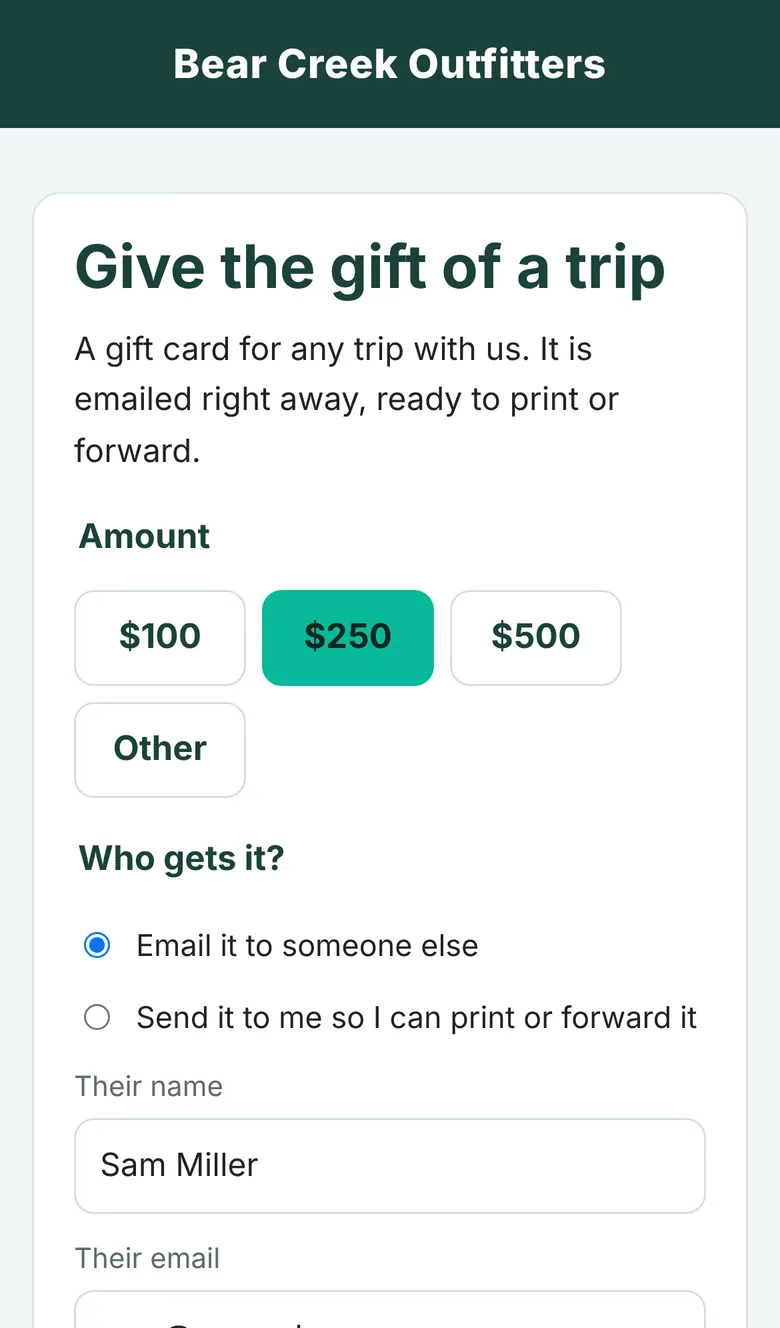
RIVERRISE BOOKINGS sells gift cards on your own website and pays them into your own Stripe account. There are no per-booking fees for you or the buyer. To see it, Book a free demo or try the demo guide service, Bear Creek Outfitters.
4. Price the cards so the math works
A gift card is a trip you have already been paid for. Make sure that payment covers the trip you will run. If you raise prices next season, a dollar-value card handles that on its own, but a card for a “full day trip” does not.
Here is an example. You sell a full day card for $600 this December, and next season the full day goes to $650. If the card is for the trip, you run it for $600.
If the card is worth $600, the recipient pays the $50 difference. Pick one approach and say so on the card.
Fees matter too. If you sell through a platform that takes a cut, that cut comes out of each card. Our fee calculator shows what different setups cost over a season.
5. Tell your past guests first
Your past guests are the best buyers you have. They know your boat, they trust you, and they know someone who would love the trip. Send them a short email in early December.
- Subject: something plain, like “A fishing trip for Christmas.”
- Body: two or three sentences, a photo, and one link to your gift card page.
- Deadline: if the card is delivered by email, say so. It makes the card a good last-minute gift.
Send one reminder in the week before Christmas. That is when last-minute shoppers are looking. Post the same message on Facebook and Instagram, and pin it to your profile until the holiday.
6. Make the card feel like a gift
The recipient opens an email or a printed card, not a fish. Give them something worth opening. Include a photo of the water, the trip name, the value, and simple steps for booking.
Offer a printable version so the buyer can put it in a stocking. A short line like “Your captain is waiting” reads better than a code and a list of terms. Keep the terms on the page, but lead with the trip.
7. Plan for redemption in spring
A gift card is only half done when it sells. The other half is getting the recipient on the calendar. Cards that sit unused become a problem for you and a disappointment for the buyer.
- Keep one list of every open card, its value and its owner.
- Email recipients when next season’s calendar opens.
- Tell them exactly how to book and use the card.
- After the trip, send a review request, the same way you do for every guest.
Gift card recipients are new guests. Treat them well and they can turn into repeat guests and buyers of next year’s cards.
A December gift card checklist
- Pick two or three card formats and write the rules.
- Check your state’s gift card rules.
- Add a gift card page and link it from your homepage.
- Email past guests in early December.
- Send a reminder the week before Christmas.
- Email card holders when next season’s calendar opens.
Fishing charter gift certificate questions
When should I start selling fishing trip gift certificates?
Have the page live before Thanksgiving, and send your first email to past guests in early December. Send a reminder in the last week before Christmas, and point out that an emailed card works as a last-minute gift.
Should gift certificates be for a dollar amount or a specific trip?
Dollar-value cards are the most flexible and handle price changes on their own. Trip cards are easier to give as a present. Many guides offer both, with clear terms on each.
What is the easiest way to sell gift cards on my website?
Use a booking system that sells gift cards on your own site, with the money going straight to you. RIVERRISE BOOKINGS does this for $99 a month with no per-booking fees, paid through your own Stripe account. Setup is $0 if you sign by December 31, 2026, so there is still time to have it running before the holidays.